Summary Of The In Depth Analysis And Live Proton Tracks
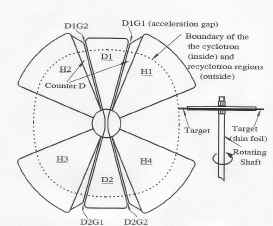
This machine is comprised of: the cyclotron region, as the accelerating module; and the proton storage ring region for acceleration and confinement. And the rotating target that is made of a thin beryllium foil in the storage ring.
We also named the combination of the storage ring, the rotating target, and the acceleration region in the storage ring "the recyclotron" region. The name "recyclotron" stems from re-cycling the proton. The proton that do not undergo a nuclear interaction reaction with the beryllium atom (the target) only lose a very small fraction of its energy. It gains the lost energy and re-strike the target.
We also found a new charged particle drift in our work. The recyclotron region takes care of this charged particle drift.
The
cyclotron region functions as a cyclotron would; all design and operational
parameters are correlated for accelerating a proton (or a charged particle) from
the central region to the target. The recyclotron region has dual functions.
In addition to the acceleration, it also confines the protons. Its latter
function is exactly the same as a proton storage ring.
As noted, in our machine, the charged particles -- protons in the present case -- that pass through the target without undergoing a nuclear reaction re-gain their energy lost to the target and re-strike the target.
The image below shows the proton trajectory in five consecutive strikes. As the number of strikes increases the proton drifts to the left. This is a new charged particle drift that was discovered in the present work. It is named the grad-E drift, for technical reason. The term "grad" is from the word "gradient." This drift, in the present case, when left alone, is an instability. It will be suppressed by modifying the magnetic field distribution. Ordinarily, the discovery of this drift by itself would have made many headlines.

The image below shows the proton trajectory in five consecutive strikes. Here, the grad-E drift is compoetely suppressed by modifying the optics.

As can be seen from the above images, in this machine, every strike that a proton makes is equivalent to doubling the beam current that reaches the target. This in turn, proportionally increases the yield of the nuclear reaction that this machine is designed for. The required energy per strike, however, is only a small fraction of the required energy by conventional means of one strike per charged particle. In this machine, a 50 mA beam for the BNCT, for example, may require around 1 mA or less output current from the ion source. Even a poorly designed ion source can easily deliver that much current.
The proton trajectories shown above is obtained from the graphic solution of the Maxwell's Equations. The procedure of obtaining the trajectories is arguably the most powerful and the most accurate way that will exactly demonstrate the actual trajectories in a particle accelerator. This procedure is also the most accurate way of seeing how a particle accelerator works.
The strength and accuracy of this method come from implementing the resonant cavity oscillation at its natural frequency, but without any correlation with the location of protons. The energy gain or loss of a proton depends on the rf phase at a gap crossing time; hence, the method, as has been proved in many situations, simulates real-life situation.
The algorithm for the above method is by me (Dr. Behrouz Amini.) It has been implemented in the Vector Fields Inc Electromagnetic Software. It was not really electromagnetic, it was electrostatic before my algorithm. What had been missing in the Vector Field software was the dynamic effect, everything else was really great. By implementing the above algorithm, their 3D electromagnetic software proved itself as the most accurate means of simulating the performance of an accelerator: how well it works or how badly it fails.
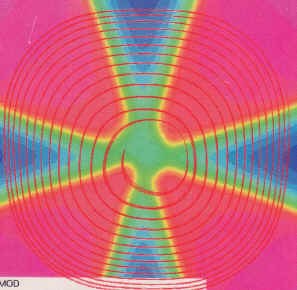
The following, shows the beam track during the acceleration in the central region of my developed PET cyclotron. (Without this PET cyclotron former CTI now know as Siemens Molecular Imaging had absolutely no option but to become non-existent. ) The beam mark taken from the cyclotron was an exact copy of the tracks shown below.
***
Changing the subject: The savage criminals who stole my works including my PET cyclotron by breach of the agreements in 1999 are five individuals who owned former CTI, together with this purely criminal institution known as Siemens through its executives and board members. These subjects are described separately. I invented the machine that I described after 1999, after they stole my works. They have been doing everything imaginable and sabotaged the development of all of my projects each and every time, including my machine.
My algorithm noted above, was an incredible invention that I had been using together with what Vector Fields had in developing new technologies before 1999. My algorithm made Vector Fields extremely valuable, after they illegally started to market my invention together with what they had. Subsequently, Vector Fields was bought by a British giant company, which is similar to a defense contractor and Aerospace version of the United States. I looked at their website. I found many applications of their software posted on their web site that are by using my invention, my algorithm.
I will provide more detailed information in the near future. Among them Vector Fields had a lot of problems initially to understand what my algorithm does before implementing it in their software for me to use. At that time I was with former CTI. I was going to pay $1000 for their time of implementing, and told them where in their software. We were in the process of buying their software.
They sent my algorithm to their headquarter in England. they could not understand it either as to what my algorithm does. They told me if it does not work the way I expected, they should not be blamed for. They said they had good reputation in the field and lectured in places like MIT. I told them to go ahead and do what I asked them to.
Once they did at our cost, they realized what they had been missing all these years. Subsequent to this begged me to let them market for basically any price we could ask for within their budget. I did not agree. It was my work, and I was going to patent it. At that time, I had no time for patenting or basically anything, spending all my time in preventing CTI from becoming non-existent.
The only thing that I agreed with was to let Chris, a PhD in charge of their program in the U.S., use it in his office only for consulting work that he was doing on the side. Chris and I knew each other and were friends. This was to help him financially. In return, Chris voluntarily waved over ten thousand dollars from the price of purchasing their software. He did not also charge for the $1000 that I agreed to pay them for their time in implementing my algorithm in their software to be used by me only.
Whether those savage criminals gave it for free to Vector Fields since they had no concept how to use it, I do not know, and is a likely event. Erasing all of my tracks had been on the top of their list since they stole my works.